aSSEMBLY
Innovative Dewatering
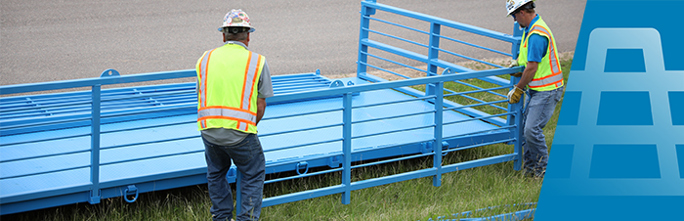
ROWD uses the idea of straw bale (or filter sock) filtration but places it in a sturdy steel frame so the amount of water that can be run through without failure is increased while maintaining the mobility of the sled. The sturdy steel construction increases durability and functionality and can withstand transport from one construction site to the next.
The skid mount design aids in mobility while the large frame and solid steel base allows for leveling on any surface. After pushing, pulling or carrying into the dewatering site, leveling is completed by placing material under the solid base to lift the edges and create an efficient dewatering structure. By locking the filter material between concentric rectangles, the ROWD sled also becomes a safer dewatering structure as heavy, water-logged straw bales are prevented from shifting and collapsing, such as in conventional structures.
The ROWD sled will arrive at your jobsite already constructed and ready for easy assembly.
Assembly Instructions
Detailed Photo InstructionsSTEP 1
Connect tow cable to the back using two shackles with sufficient rating for work at hand. For ROWD sleds without the front tow plate, connect tow cable with shackles with sufficient rating for work at hand. NOTE: Sleds equipped with tow plate and hook do not need a cable on the front.
STEP 2
Insert back gate panel into stake pockets. Then insert side panels into stake pockets & pin in corners. Secure pins with hitch pin. NOTE: Side panels have location marked on the top corner by the pin ear.
STEP 3
Open two gate panels on one side to access the inside of the ROWD sled. Install a single bottom row of straw bales on three sides and add filter fabric across the base of the sled and over the row of straw bales. NOTE: Filter fabric or geotech can be used.
STEP 4
Insert inner ring panels to secure filter material in place. Pin corners and secure with a hitch pin. NOTE: Inner ring panels set on top of the filter fabric liner.
STEP 5
The complete bottom row of bales on the side with open gates, folding filter fabric over the top when complete. Close gates. NOTE: At this time, the inner and outer rings should be in place with a single row of straw bales around the perimeter, and filter fabric under the inner rind and over the bottom row of bales.
STEP 6
Install top row of straw bales above filter fabric and bottom row of bales. Unit is now ready for a filter bag.
STEP 7
Put filter bag remover in center of inner ring and lay filter bag on top of filter bag remover.
STEP 8
Put piping inlet on ROWD and connect hose to filter bag. NOTE: Make sure filter bag is securely connected to hose.
STEP 9
Periodically monitor while pumping.
STEP 10
Replace straw bales, filter bag and filter fabric as needed.
STEP 11
To replace bales, remove used filter bag, unpin inner panels, pull out top row of bales, then inner panels, then filter fabric and then pull out lower row of bales. Repeat steps 3-9
FILTER FABRIC
- Use filter fabric to line structure instead of geotech; filter fabric has improved filter capabilities and flow rates over geotech.
- Geotech or filter fabric can be precut to 12 feet x 24 feet for a standard ROWD sled.
- The largest optional filter bag is 4.5 feet x 16 feet for a standard-size ROWD sled.
- Remove the old filter bag before installing a new filter bag.
- Using filter fabric instead of geotech allows water to filter through both the lower row and top row of bales. This is important on uneven ground.
- Approximate Number of Straw Bales Held: 36
- Approximate LF of 18-inch Filter Sock: 150
- Filter Bag Size: 5-Foot x 15-Foot
PUMP & HOSE
- Make sure the bag to hose connection is tight and sturdy.
- In the event problems are identified with the pump, structure or downstream of the structure, cease pumping and make adjustments.
- The two inlets are not for hooking up two pumps to one filter bag.
OTHER TIPS & TRICKS
- Hang extra hose clamps, screwdriver or wrench on the railing to connect filter bag.
- Extra filter bags can be bagged and tied to the back of ROWD sled.
- Mulch topsoil or right-of-way with spent bales to reduce waste.
The ROWD sled has been reviewed and tested with reports on structural calculations to determine limitation of design and flow rate. Results show that ROWD's steel construction eliminates the chance of collapse under continued operating conditions, and the easy transport and re-usability of ROWD cuts down abandoned structures on project sites.